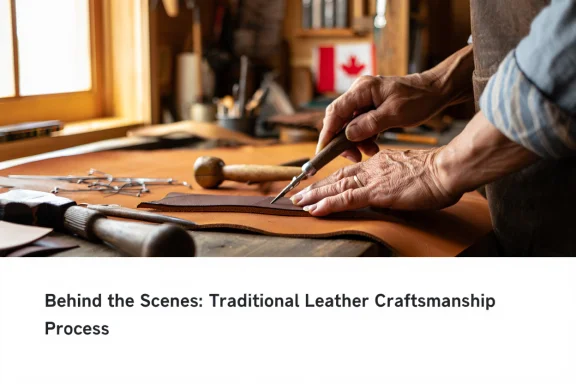
Step into our Queen Street West workshop and you’ll hear something remarkable – the rhythmic tapping of mallets, the whisper of sharp knives through premium leather, and the gentle hum of craftspeople completely absorbed in their work. This is where leather transforms from raw material into heirloom-quality goods through techniques passed down through generations of artisans.
At CraftLeather Canada, we believe that understanding our process helps you appreciate why handcrafted leather goods command premium prices and deliver exceptional longevity. Let’s pull back the curtain on traditional leather craftsmanship and show you exactly what goes into every belt, wallet, and bag that leaves our Toronto workshop.
The Foundation: Selecting Premium Leather
Before any cutting or stitching begins, our process starts with the most critical decision – choosing the right leather. Not all hides are created equal, and our artisans inspect every piece with the trained eye that comes from years of experience.
Our Leather Selection Process:
Full-Grain Inspection: We examine each hide for natural markings, grain consistency, and thickness variations. Full-grain leather retains the hide’s original surface, including natural imperfections that add character and ensure authenticity.
Touch and Flexibility Tests: Premium leather should feel supple yet substantial. Our artisans test flexibility, checking that the leather bends without cracking while maintaining its structural integrity.
Thickness Consistency: Using precision gauges, we measure leather thickness across different sections. Consistent thickness ensures uniform stitching and professional finishing.
The leather that meets our standards gets sorted by project type. Belt leather needs different characteristics than wallet leather, and our artisans match materials to their intended use based on decades of combined experience.
Traditional Pattern Making: Precision Before Production
Modern technology might offer shortcuts, but traditional pattern making ensures accuracy that machines can’t replicate. Our master craftspeople create templates using techniques that haven’t changed in generations.
Hand-Drawn Templates and Precision Cutting:
Each pattern starts as a hand-drawn template on sturdy cardboard or thin wood. These aren’t quick sketches – they’re precision instruments that account for leather stretch, seam allowances, and the specific characteristics of different leather types.
When it’s time to cut, our artisans use razor-sharp knives rather than die-cutting machines. Hand-cutting allows for real-time adjustments based on the leather’s natural grain direction and any unique characteristics of individual hides. This attention to detail means every piece is optimized for both strength and appearance.
The Heart of Craftsmanship: Hand-Stitching Mastery
Machine stitching is faster, but hand-stitching creates superior durability and allows for the precise control that defines premium leather goods. Our saddle-stitching technique uses two needles working simultaneously to create interlocked stitches that won’t unravel if one thread breaks.
Traditional Saddle-Stitching Process:
Thread Preparation: We use heavy-duty waxed thread that’s been conditioned for flexibility and longevity. Each stitch line gets measured and marked using traditional spacing wheels.
Hole Creation: Rather than punching straight through, our artisans use awls to create angled holes that accommodate the natural direction of hand-stitching. This prevents leather tearing and creates cleaner stitch lines.
The Two-Needle Technique: Saddle-stitching requires both hands working in coordination. Each needle passes through the same hole from opposite directions, creating an interlocked stitch that’s stronger than any machine can produce.
The rhythm of hand-stitching can’t be rushed. A premium belt might require 4-6 hours of stitching time, but the result is a seam that’ll outlast the leather itself.
Edge Finishing: Where Craftsmanship Meets Artistry
The edges of leather goods reveal the maker’s skill level more than any other element. Machine-finished edges look uniform but lack the character and durability of hand-finished edges.
Our Multi-Stage Edge Finishing Process:
Initial Shaping: Raw leather edges get carefully trimmed and shaped using specialized knives. Each cut must be precise – there’s no going back once leather is removed.
Sanding and Smoothing: Progressive grits of sandpaper create increasingly smooth surfaces. This stage requires patience – rushing creates scratches that’ll show in the final product.
Burnishing: Using traditional bone folders and wooden burnishing tools, artisans compress and polish edges until they achieve that characteristic smooth, almost glass-like finish. This process can take 30-45 minutes per edge for complex pieces.
Sealing: Multiple coats of edge paint or wax create weather resistance while maintaining the hand-finished appearance that distinguishes artisan work from factory production.
Quality Control: Standards That Define Excellence
Every piece undergoes rigorous inspection before it earns the CraftLeather Canada mark. Our quality standards aren’t negotiable – they’re what separate handcrafted excellence from mass production.
Our Multi-Point Inspection Process:
Structural Integrity: Every seam gets stress-tested. Stitching receives microscopic examination for consistency and tension. Hardware attachment points get checked for proper reinforcement.
Aesthetic Standards: Color matching, grain alignment, and edge finishing all receive detailed inspection. Even minor imperfections that wouldn’t affect function can disqualify a piece from our collection.
Functional Testing: Wallets get loaded with cards and bills. Belts get flexed through their full range of motion. Bags get packed and carried. We don’t ship anything we wouldn’t be proud to use ourselves.
The Time Investment: Why Handcrafted Takes Longer
A machine can punch out leather goods in minutes, but authentic craftsmanship measured in hours or days. Here’s why the investment in time creates superior products:
Typical Production Timelines:
- Premium Belt: 8-12 hours from cutting to final inspection
- Handcrafted Wallet: 6-10 hours depending on complexity
- Leather Bag: 15-25 hours for detailed construction
- Custom Pieces: 20-40 hours including design consultation
This time investment isn’t inefficiency – it’s what creates products that improve with age rather than falling apart after a few months of use.
Traditional Techniques in a Modern Workshop
While we honor traditional methods, we’ve thoughtfully integrated modern tools that enhance rather than replace artisan skills. LED lighting reduces eye strain during detailed work. Precision measuring tools ensure consistency. Climate control protects leather and maintains optimal working conditions.
But the core techniques – hand-cutting, saddle-stitching, burnishing, and quality inspection – remain unchanged from methods perfected generations ago.
Why Traditional Craftsmanship Matters Today
In a world of fast fashion and disposable goods, traditional leather craftsmanship represents something increasingly rare: products designed to last decades rather than seasons. Every technique we use, from hide selection to final inspection, contributes to longevity that makes handcrafted leather goods a smart investment.
When you understand the process behind authentic craftsmanship, the value becomes clear. You’re not just buying an accessory – you’re investing in techniques perfected over generations, applied by artisans who take pride in creating something built to last.
Ready to experience the difference traditional craftsmanship makes? Visit our Toronto workshop to see these techniques in action, or explore our collection of handcrafted leather goods where every piece represents hours of dedicated artisan work.